
How to Cuff Selvedge Jeans With Sneakers and Boots
By CHILLMIND
Put on the shoes you wear most and take a look at the back of your jeans. If the hem brushes the floor, turn it up once and take a few steps. Start with about an inch (2.5 cm) of denim. You can always unfold it and start again.
On many pairs of selvedge jeans, that first fold reveals a narrow woven strip at the outside seam. Look just to either side of the dark seam in the cover photo. Those two pale strips with red threads are the woven edges of the denim. See how the woven edge ends up inside the jeans.
Start with a single cuff
Turn the hem outward and up about an inch. Feel for the outer seam with your thumb and press the fabric flat there. Work around to the inside seam, then match the fold on the other leg. You’ll see the original hem stitching at the top of the cuff.
If one cuff angles up while the other runs straight, take the jeans off and lay both legs beside each other. Measure the depth of each fold at the outside seam, then check the inside seams. If the cuff twists, slip a thumb under the fold and line those seams up with the seams above them. Smooth any small puckers with your palm before you try the jeans on again.
Try it with your sneakers. With a low-top, I’d start with the cuff just brushing the top of the shoe. If you want to see more of the laces, raise the fold a little and check again from the side. The front can look right in a mirror while the back still catches under your heel.
When a double cuff makes sense
Take that first cuff and fold it upward again. The original stitching tucks away inside the second fold. Two one-inch folds take up about two inches of length, even though the band you see is still about an inch high.
Feel the side seam after the second fold. There’s more fabric packed into that spot, especially on heavier denim. If it sticks out like a little shelf, undo both folds and try one deeper turn-up. A quick check in the mirror will show which one sits closer to the leg.
A bootcut gets wider near the hem. Fold it far enough and you may find yourself trying to wrap the widest part of the leg around a narrower section. If you see a ripple running out from the seam, unfold the cuff and try a slightly shallower roll. Keep the top of the fold level as you work around the leg.
Check the cuff with your boots on
Pull the leg down over the boot and walk across the room. Some cuffs settle right back into place. Others catch on the top of the boot and stay there after you take a step. If yours catches, unfold it and try a different depth. Check it again after sitting down. That’s when the hem can ride up and catch on the way back down.
If you switch between boots and flat sneakers, set your phone near the floor and film a few steps from the side in each pair. Pause on the foot that’s behind you. That’s where you’ll see if the denim is about to slip under the heel or if it’s riding up on the shoe. You might like the hem down over your boots and a shallow cuff with your sneakers.
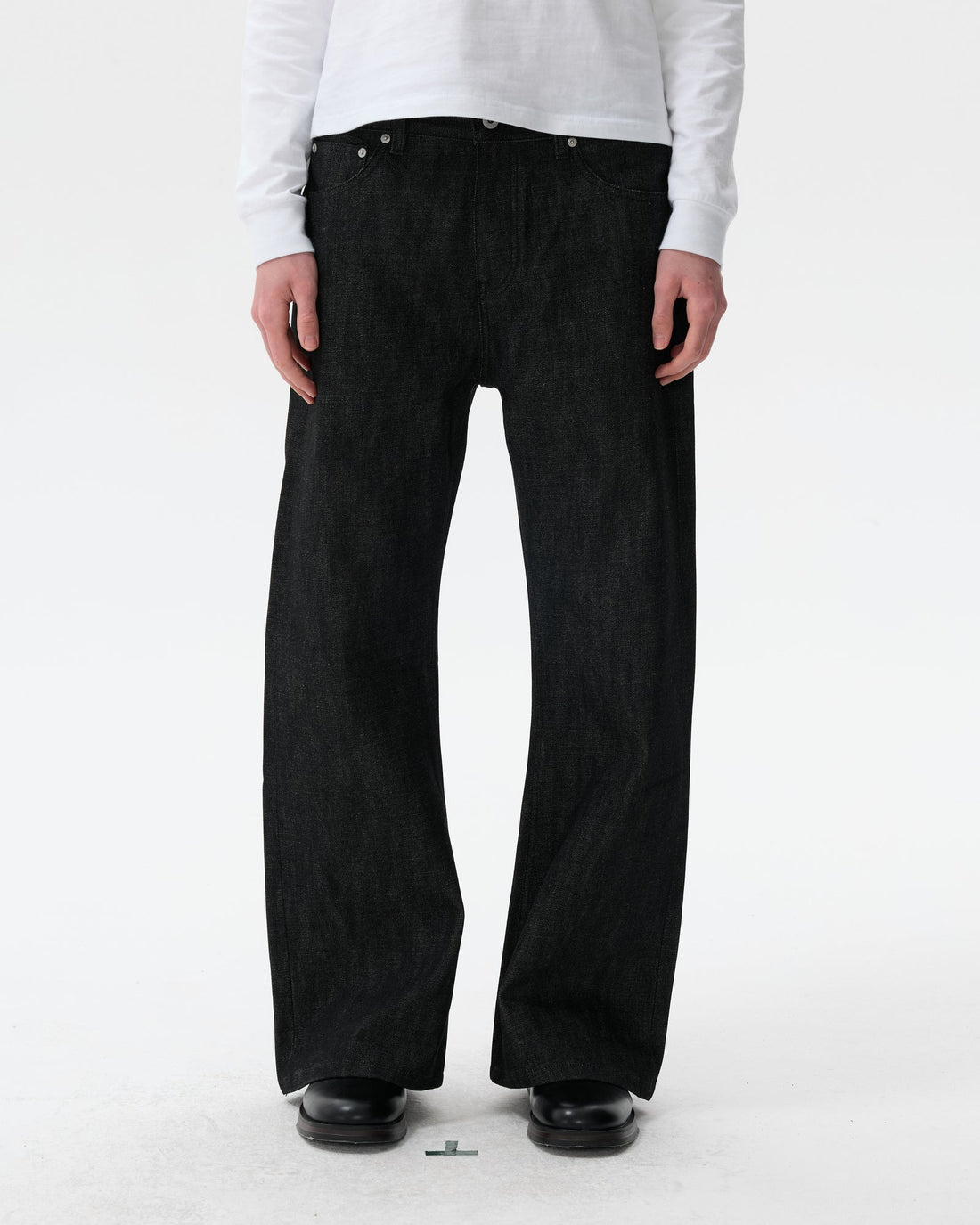
Here’s how our black Bootcut falls at its original length. Our model is 185 cm / 6′1″ and wears L. That size measures 30 cm / 11.8 in flat across one leg opening and 109 cm / 42.9 in along the outside leg. You can see how much of the shoe the hem covers in front. Use that photo as a starting point, then check the side and heel with your own shoes. See the black Bootcut from the side and check the size chart.
Before you get them hemmed
If you roll the same pair every time, wear your usual cuff for an afternoon and see where it settles. If you still want the jeans shorter, bring your everyday shoes to the tailor and ask them to pin a leg so you can walk a few steps in it.
On a bootcut, lay a ruler across the leg at the pinned line. Compare that width with the original hem. Shortening can move the opening to a narrower part of the leg, which changes how the denim falls over your shoe. If you plan to wear both a cuff and a plain hem, try both at the pinned length before anyone cuts the fabric.